Categories
Educational Event Newsletter

Green Committee Accomplishments Honored by Upper Nyack Board of Trustees

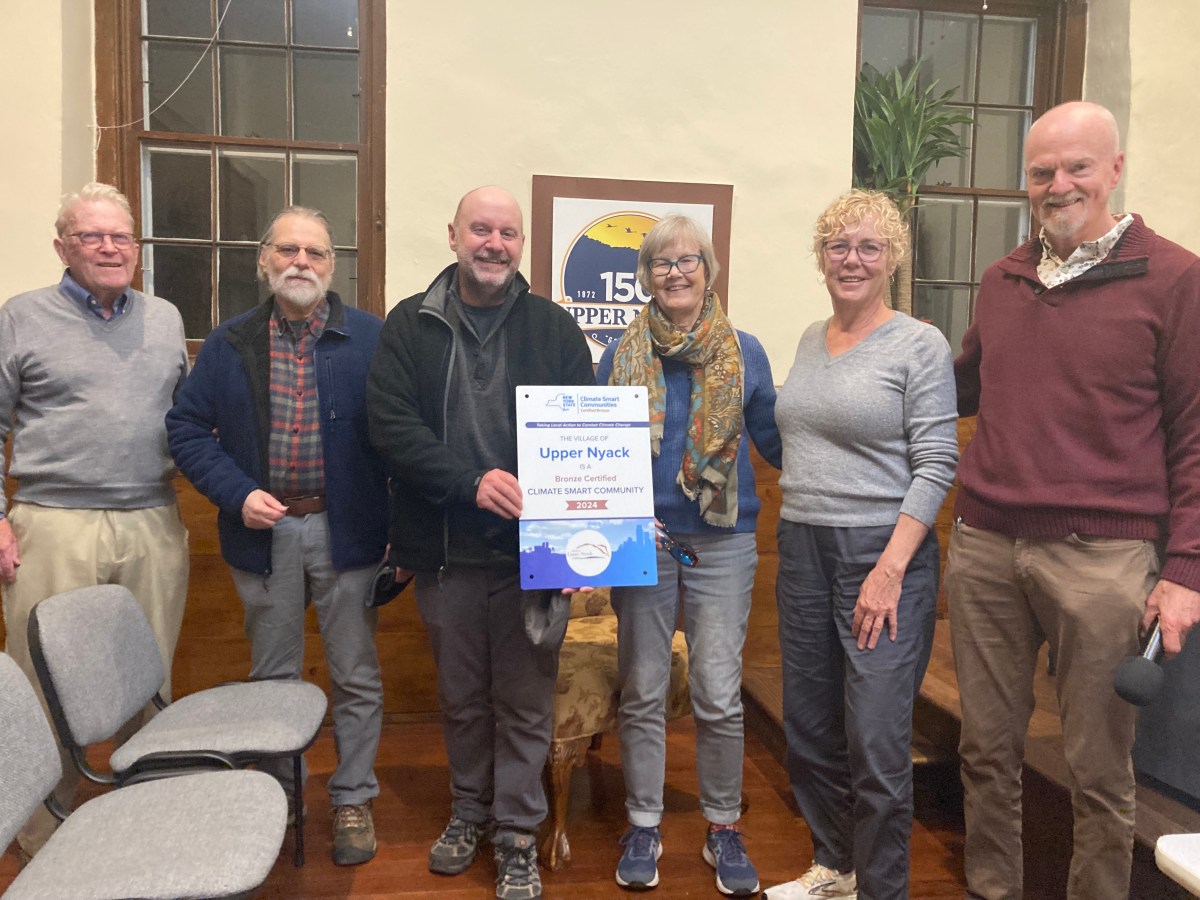
It was a special moment at the Upper Nyack Board of Trustees meeting on Thursday, October 17, when the Green Committee was thanked for the hard work and successes that our members have helped the village achieve. There is brand new plaque proclaiming Upper Nyack as a Bronze Certified Climate Smart Community. Pictured above, from left to right: Bill Ryan, Rob Picardi, Addison Chappell (co-chair of the Climate Smart Task Force, together with Peggy Kurtz, who joined the meeting online), Judy Ryan, Mayor Karen Tarapata, and Harry Vetter, Green Committee chair. The Committee is grateful for all its members who chipped in hours of work for helping the village achieve this status. It is just the start of an ongoing process to improve our village’s, and the region’s, sustainability. Upper Nyack residents: Your help, ideas, and volunteering in the coming months and years are much needed and appreciated!

Categories
Educational Event

Upper Nyack Wins Bronze Certification for Climate

The Village of Upper Nyack has achieved the New York State Bronze Certification as a Climate Smart Community, highlighting its commitment to sustainability and environmental stewardship. This certification recognizes the village’s comprehensive efforts to reduce greenhouse gas emissions and enhance resilience to climate change, largely driven by the initiatives of the Upper Nyack Green Committee and the Climate Smart Communities Task Force. Their dedication to energy efficiency improvements, community engagement, and strategic planning has played a crucial role in advancing climate-friendly practices. By implementing these initiatives, Upper Nyack not only demonstrates leadership in combating climate change but also sets a precedent for other communities aiming to pursue similar environmental goals. Read more in the Rockland County Business Journal article here. Read more about Climate Smart Communities here.

Categories
Educational Newsletter

What Can I Do To Save Money and Help Our Climate?

Four fun and easy ways to save money and energy in your home right away!

by Suzanne Buchauer

“Help!  The climate crisis seems too big, and I just don’t know where to start!”, you might hear or even say.  How frustrating and draining! If only there was a way to save more money and help the environment at the same time…

When ready, here are four strategies to find relief from your worries about saving money and reducing your energy costs.
1) Make an attic stair insulation box or buy a kit.

A video showing how to make an attic stair insulation box.

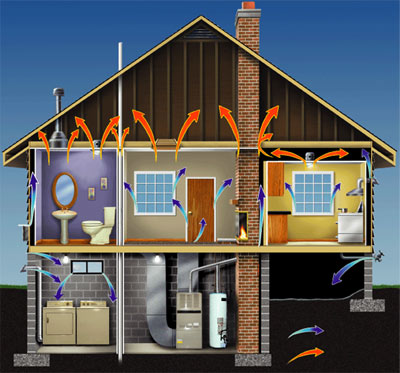
EPA estimates that homeowners can save an average of 15% on heating and cooling costs (or an average of 11% on total energy costs) by air sealing their homes and adding insulation in attics, floors over crawl spaces and basements. (Internet search)

Insulation in an attic opening.

2) Stuff insulation up the fireplace if you don’t use it.  There are also kits to do this:

Here, we put insulation up the chimney, and we will be adding another cover soon.  We don’t use this fireplace.

3a) Dry laundry indoors, near the boiler, in the winter, or in the bedroom for some humidity.  

In Europe, washing machines are not sold WITH dryers, generally. Becoming creative, you can find a way to hang even long bedding.  We hang our laundry all year round and we use a dryer extremely rarely. (See pole for ideas on hanging sheets and bedding below, in tight spaces)

Project Laundry List estimates the average household could save 10 to 20 percent on utility bills by hanging the wash! Line drying laundry also protects the environment, protects the clothing, and conserves energy for your fellow man. (Internet search)

Several laundry racks.

Here you can see several hanging rack options, which fold nicely: three-tiered tower; long rack, with sides that pull out; foldable long rack; plus, an adjustable V-shaped rack that fits into small spaces easily.

3b) Buy a pole to put up over door/window jams in tight spaces, to hang bedding.  The longer sheets can be folded and hung on plastic hanger, until somewhat dry, then unfolded and turned around, or placed on the long racks to dry, spread out—Tip: keep the door open to the room where laundry is being hung, to help with circulation—near a heater is easy as well:

A woman demonstrating hanging laundry from a raised pole.

4) Buy cellular blinds, which will save significantly on energy, day and night—all year round.  They are like blankets for the windows and REALLY make a huge, noticeable difference in feel (inside comfort), in cost and in energy savings.  They keep the cold and heat out!

Cellular blinds hanging in front of a window.

These shades can reduce wintertime heat loss by 40% or more. During a heating season, that equals an energy savings of 10%! During months when you rely on air conditioning, cellular shades reduce solar heat by 60%. Used year-round, cellular shades can lower your total energy consumption by as much as 15%. (Internet search)

Please let me know your energy saving ideas that are working at your home. Together we can make a difference.

Portrait photo of the author.

suzanne@dyslexia-works.com
Happy exploring for ways to save on money and energy, in your
homes.

Categories
Event

Next Week (February 7): Nyack Climate Solutions Fair

Don’t miss the upcoming Nyack Climate Solutions Fair on Wednesday, February 7 from 7:00-9:00 PM at the Nyack Center (58 Depew Avenue).

All sorts of exciting local groups and initiatives will be represented, including the Upper Nyack Green Committee. Join us to learn more from neighbors and to get involved in these community efforts!

Categories
Call to Action Educational Event

New Program for Upper Nyack Residents to Reduce Energy Use…and Reap Rewards!

Join your neighbors in helping our community fight climate change!  

As we try our best to get through these tough heat waves, nearly all of us are using more energy for cooling, whether for air conditioning or fans.  Most of us don’t think about the fact that on peak days for electricity usage, utilities bring on the most polluting power plants to cover the demand.  Read below for one way you can help to cut your peak demand, reduce your carbon footprint, and also save money!

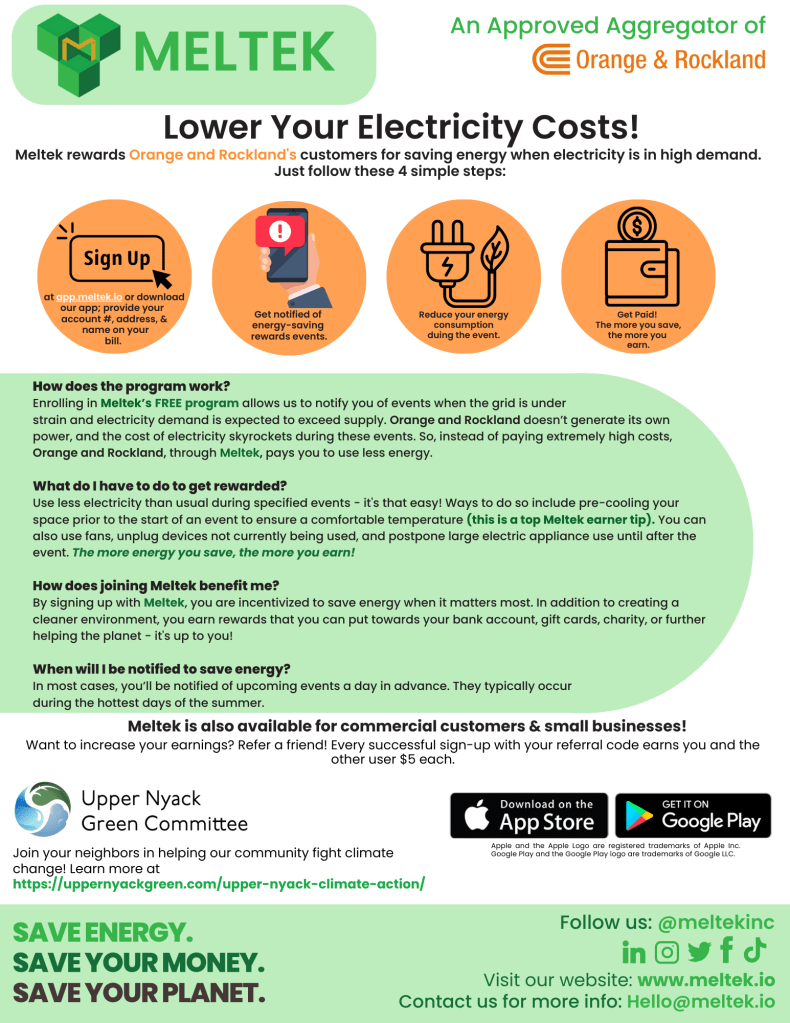
The Upper Nyack Green Committee is promoting a new program to lower your energy use, reduce your carbon footprint – and save you money.  This program, called Meltek, is entirely free and is authorized through Orange & Rockland.

Meltek can help you reduce your energy use at peak times on hot summer days.  By voluntarily shifting our energy use to off peak hours – and by becoming more efficient, we can reduce the use of the dirtiest power plants on peak hot days.  

Meltek alerts participants ahead of time to peak electricity demand days – and gives you ways to reduce your energy use — and shift it to off peak.  You get paid for reducing your energy use, or you can donate the savings to charity, to plant trees, or to buy carbon offset credits.  All of this is voluntary.

When we do this as a community, we can truly make a difference!

You can learn more at www.meltek.io and sign up or download the Meltek app at app.meltek.io.

Categories
Educational Newsletter

Celebrating Neurodiversity and our Nature  on Autism Acceptance Month 


by Suzanne Buchauer

While hiking the Long Path along the historical Hudson River yesterday, it dawned on me just how many autistic/neurodiverse individuals ended up contributing to our efforts to interpret, understand, and discover our world. The neurodiverse people below have helped broadened our collective knowledge, understanding, and wisdom about our natural world. It is a common trait of autistic individuals to be extremely focused, detail-oriented, and passionate about their particular topic of interest. Those are only a few of the talents, gifts and strengths of being neurodiverse.

Let’s take a moment to remember, to contemplate and celebrate neurodiverse individuals, whose love of animals and our natural world has made huge impacts on our lives.

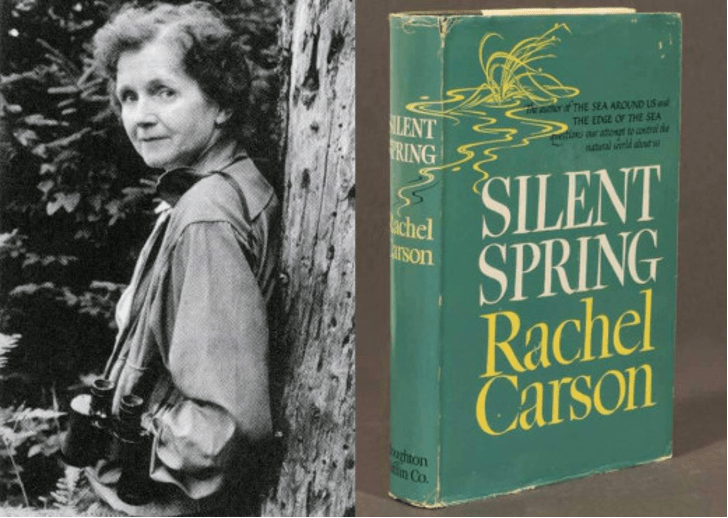
Rachel CarsonBiologist, writer and ecologist

Carson’s passionate concern in Silent Spring is with the future of the planet and all life on Earth. She calls for humans to act responsibly, carefully, and as stewards of the living earth.  Michael Fitzgerald of Trinity College in Dublin explored her life and personality with the traits and characteristics of what we call being on the autistic spectrum and wrote a subsequent research paper called:  Rachel Carson was on the Autism SpectrumYou can read the paper here.

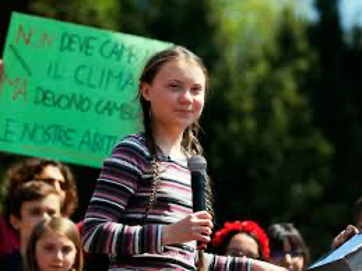
Greta Thunberg—Swedish climate activist

Greta has captured the hearts of many in the world.  She is passionate about getting the word out about climate change.  Greta is particularly well known for challenging world leaders to take immediate action for climate change mitigation.

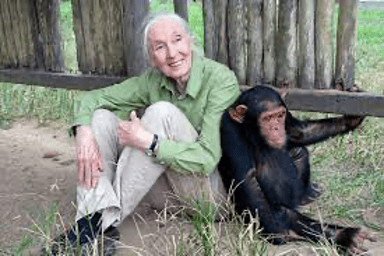
Jane Goodall—Primatologist and Anthropologist

Jane Goodall was the first person to observe chimpanzees using tools—a trait that was thought to be uniquely human.  The discovery helped shape the way we see animals and ourselves.

See this excerpt from Temple Grandin (Chapter 8: “Wildlife”) which discusses Jane Goodall’s work and the connection with strength based autistic traits.

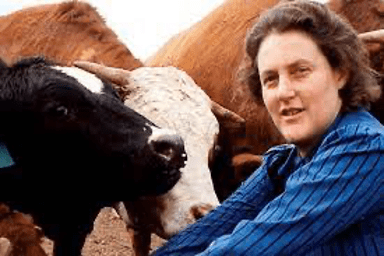
Temple GrandinProfessor of Animal Science at Colorado State University

She is a consultant for livestock handling equipment design and animal welfare.

Temple Grandin has contributed so much to our understanding of ourselves, animals and clearly explains how many neurodiverse people see the world.  Her most recent book is called Visual Thinking, and is a must read for anybody who wants to understand themselves or others who are neurodiverse. Reading all of her books is super helpful as she compiles research to help us understand ourselves and the natural world.  Here are my personal picks for all people, though they are children’s books.  All children can benefit from these books about getting out into the real world and doing things with their hands:

Calling All Minds—How to Think and Create like an Inventor, by Temple Grandin

The Outside Scientist—The Wonder of Observing the Natural World, by Temple Grandin

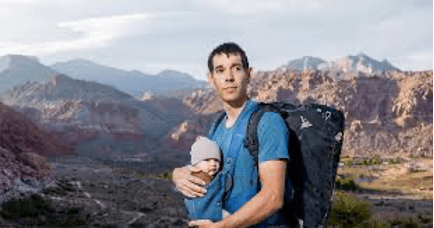
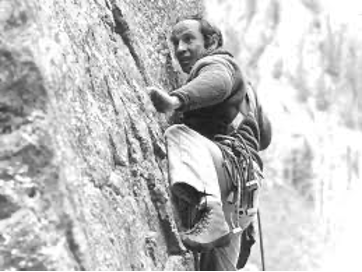
Alex HonnoldRock climber and solar energy advocate

Honnold admits to being “somewhere on the spectrum”.  He has a love for climbing, the outdoors and for adventure.  He is now a father and has stepped back from dangerous solo climbing for his family.  He has founded the Honnold Foundation, which is a non-profit to reduce environmental impact and address inequality by supporting solar energy initiatives worldwide.

Dara McAnulty—Author and iWill ambassador

McAnulty works with young people and working to save our environment.  He has experience with biodiversity, wildlife and the landscape of Fermanagh in Northern Ireland.

Daryl Hannah—Actress and Environmental Activist

Hannah is a board member of the environmental Media Association.  She co-founded Biodiesel Alliance to advocate for sustainable biodiesel practices and coordinate communication for sustainable energy future that benefits all sectors of our society.

Yvon ChouinardRock climber, business leader, and philanthropist

Yvon is an  “alternative self-made businessman (who) taught us inspiring lessons on how to perceive the world and our lives as an ephemeral journey. We are only guests on a temporary planet.”  Yvon was reported to be a “loner and a geek” as a child. He found climbing by scrambling on rocks.  He is well known as an inventor for innovative gear developments for climbers, like ice axes, crampons, etc.  He founded Patagonia and has recently made history by donating 98 percent of Patagonia’s common shares, to a newly established nonprofit organisation, which will be the recipient of all company profits and be used in funds to combat climate change. 

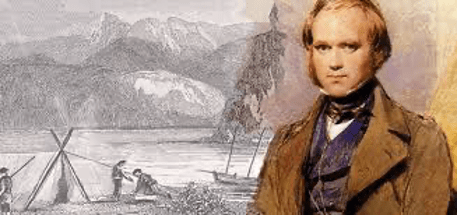
Charles Darwin—Naturalist, geologist and biologist

Darwin was an intrepid explorer and accomplished naturalist.  His love of  nature and his ability to explain his observations and findings, such as adaptation and natural selection was key to our understanding of modern science and our view of the natural world today and ever thereafter.

These are just a few of the people who are very likely humans on the spectrum and/or otherwise neurodiverse, and who love nature.  We need neurodiversity and the  innovative thinkers and doers who get out there and make invent, explore, and do.  Thankfully, many big donors and doers love our environment, so with the increase in neurodiversity, there is a chance for us and our earth! 

Being neurodiverse is very cool and in, useful and empowering; in the words of Temple Grandin:

“What would happen if the autism gene was eliminated from the gene pool?” You would have a bunch of people standing around in a cave, chatting and socialising and not getting anything done.”

Temple Grandin

May all thinking types be celebrated, appreciated and embraced, this month and every month.  Happy exploring everybody!

Suzanne Buchauer is a Davis Dyslexia Correction Facilitator and Autism Approach Facilitator living and working in Upper Nyack, New York. Visit: www.dyslexia-works.com.

Categories
Educational Event

Nyack 2030 Climate Action Plan workshop

The Village of Nyack is hosting a public workshop on March 22 to kick off the Nyack 2030 Climate Action Plan project. Nyack is creating a plan with concrete, ambitious steps we can all take to reduce our greenhouse gas emissions and help our community adapt to climate change impacts.  Upper Nyack and other area residents are invited to attend.

Categories
Newsletter Op-Eds

Despair Won’t Solve the Climate Crisis 

by Talia Reiss 

As young people post feelings of hopelessness about climate change, social media is becoming a cesspool of climate nihilism. 

“We could be extinct in less than 30 years,” exaggerated one Tiktok user. Though concern about eventual human extinction is justified, there is no evidence to suggest that it will happen in the next 30 years. Another TikTok user wrote, “Climate and environmental [advocacy] seems so hopeless in a corporate ruled capitalist world. It feels like we’re just sitting back and watching it all end.” 

No one can blame young people for their eco-anxiety. Recent trends reported by the Environmental Protection Agency show that climate change is escalating quickly, and most people can see the consequences in their own communities. In 2022, the world saw unprecedented heat waves, floods, wildfires, earthquakes, and tropical storms. 

This is a scary reality, which is precisely the reason that people deny climate change. Pretending climate change isn’t real allows people to avoid anxiety about the future and absolves them of any responsibility to fix it. But publicly pouring out feelings of despair isn’t going to change a climate denier’s mind; it actually does quite the opposite. Logically speaking, if people deny climate change because they don’t want to feel fear, giving them more to be afraid of will only make them more likely to deny climate change. 

Not only does climate despair discourage people from joining the movement, it can turn existing environmentalists away from the movement, too. When we push the narrative that the planet is already doomed, it tells environmentalists that our efforts are pointless and that we are helpless in the face of an unstoppable catastrophe. From there, it’s easy to become paralyzed by fear. Instead of actively pursuing a more sustainable lifestyle, we begin to disengage from the problem because it feels overwhelming and anxiety-inducing. 

It’s true that individual action alone is not enough. According to a 2017 article published by The Guardian, 100 companies are directly responsible for 71% of global greenhouse gas emissions.  So why should we bother with individual action? 

Consumers hold the power in our capitalist system. Corporations rely on consumers to make a profit, so when we stop contributing as heavily to harmful industries, the financial pressure forces profit-hungry corporations to compromise. So even though small actions like opening the windows instead of turning on the air conditioner or eating a few vegetarian meals a week can feel futile, we’re playing a vital role in making industry more sustainable. 

Making changes in our personal lives reinforces our commitment to the environment and keeps us engaged in the broader movement. At the very least, individual action can help us feel like we’re in control, which empowers us to fight harder for systemic change. Local organizations like Keep Rockland Beautiful, Rockland Sierra Club, and 350 NJ-Rockland are great places to get involved. 

It’s okay to feel anxious about climate change, but spreading despair on social media is not the solution. We have good reason to be hopeful: with the Inflation Reduction Act of 2022, we have taken a historic step towards reducing greenhouse gas emissions and mitigating the effects of climate change on low-income communities. We can solve this, but only if we channel our eco-anxiety into a movement that will push us towards a more sustainable future. 

Talia Reiss is a senior at Nyack High School and editor-in-chief of the Nyack Spectrum.

Categories
Educational Event

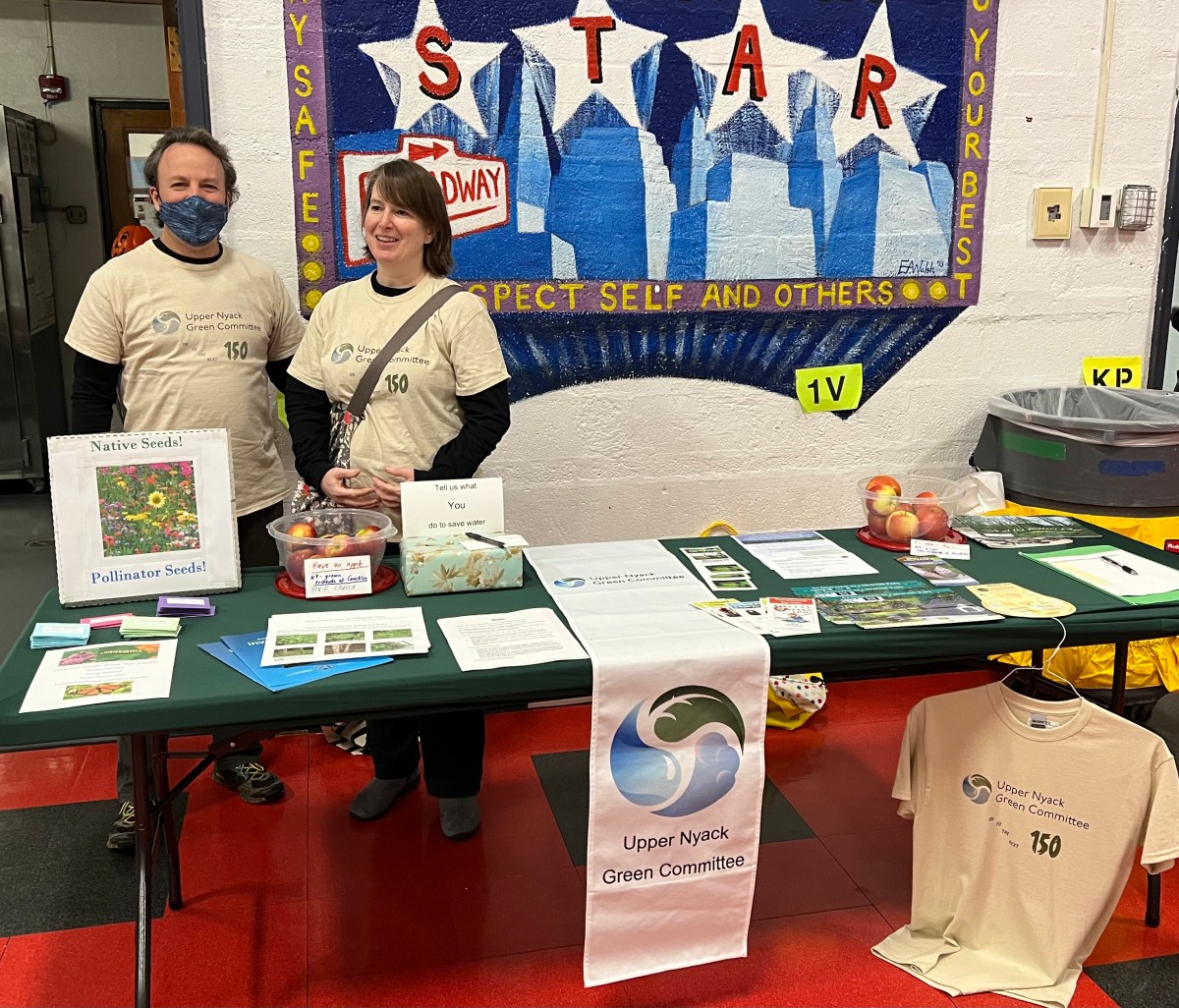
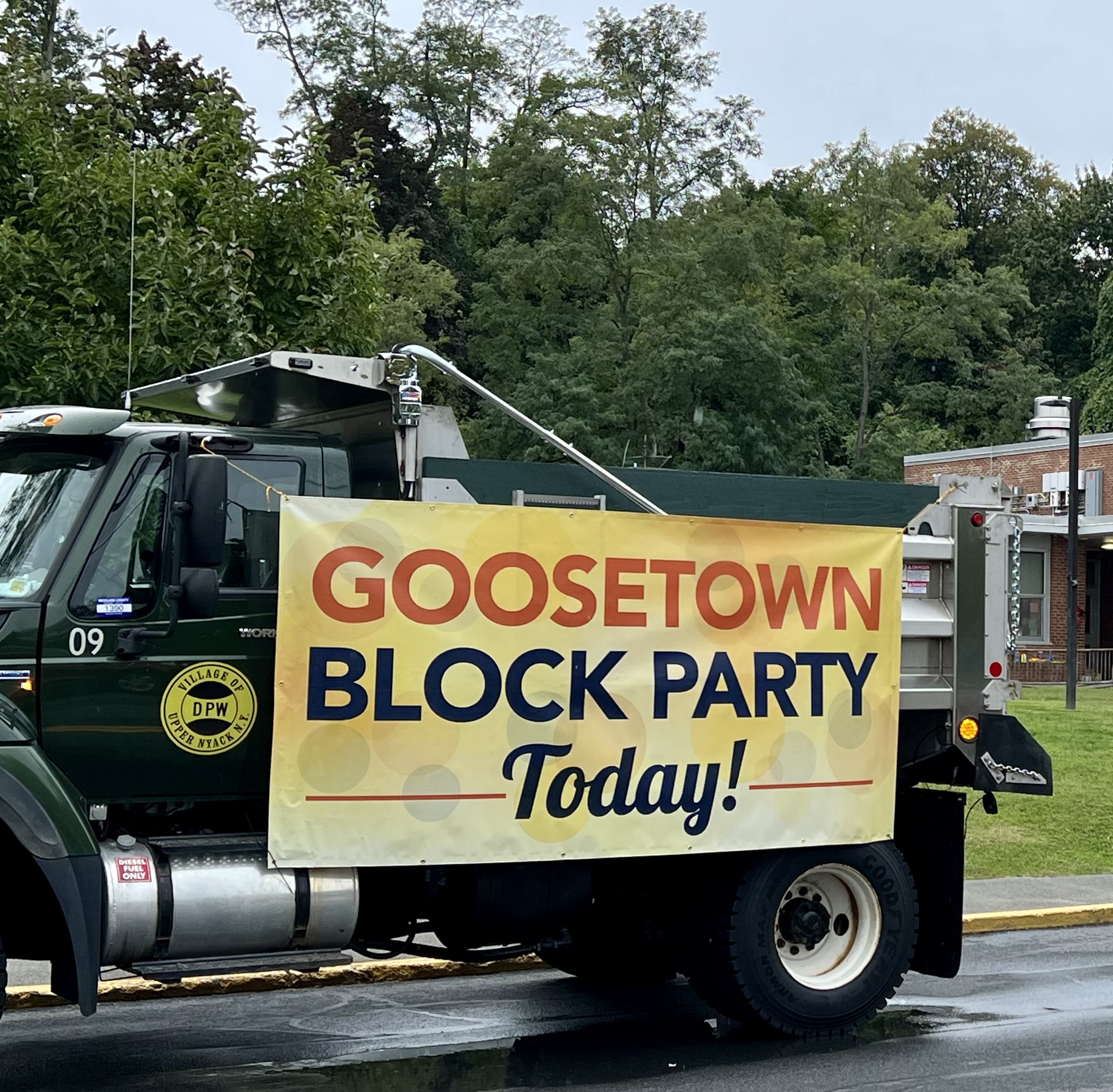
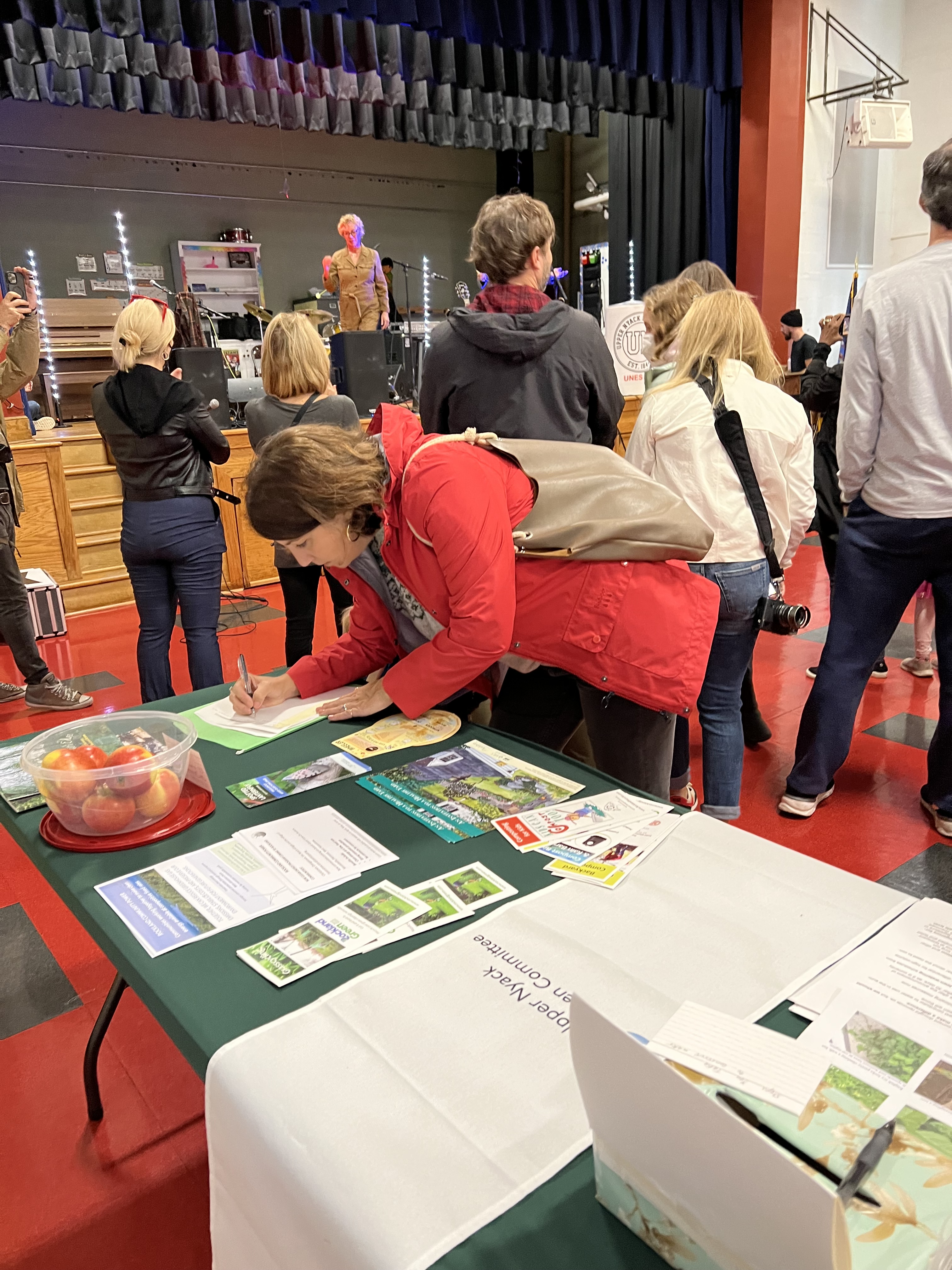
Outreach at the Upper Nyack Block Party

Representatives of the Green Committee recently joined other residents to celebrate Upper Nyack’s 150th anniversary at the village block party. Due to the weather, the events moved largely indoors. The Green Committee table saw plenty of curious visitors, including many kids. The seeds we handed out and the New York orchard apples were big hits. The topics of highest interest among residents were: invasive plants and what to do about them; composting; learning about water conservation; lantern flies (several spottings in Nyack, some in Upper Nyack); and noise and air pollution from gas-powered lawn equipment.


Thanks to all who helped the Green Committee in its outreach!

Categories
Educational

Upper Nyack Youth Share Their Concerns and Hopes for Our Climate

Suzanne Buchauer of the Upper Nyack Green Committee asked students and youth in Upper Nyack about climate change.

 What are your concerns about climate change? 

 What do you want your village to do about it?

Upper Nyack High School students from Mr. Perry’s classes responded:

Sam G., aged 14, writes: (I am concerned about) people not caring about global warming and not doing anything about it, making us go past the point of no return, when it’s too late and we can’t reverse most of what we’ve done.

Sam would like the village to: plant more trees instead of cutting so many down in Upper Nyack. He would like to see more support for people to get solar panels.

Chloe F., aged 15, writes: My concerns are that soon the world won’t be a comfortable place to live because of the extreme heat and cold.  Also, that there won’t be enough materials/resources for all the growing number of people.

Chloe would like to see the schools actually putting the recycling into the recycling bins and not mixing it with the trash.  Also, It would be great to see a ban on plastic utensils and plastic straws in the schools.  Replacing them with biodegradable utensils would be a great start.

Gabe B., aged 16, writes: I am concerned about the indefinite aspects of climate change, how there really is no complete stop to it, just reduction.  I am concerned about future generations and how they will have much more lung issues.

Gabe would like to see the village: plan some events where you can go with a group to spaces to help out.  Either clean up groups or groups to go rebuild communities that have been destroyed by climate change, related events would be welcome in our community.

Lily A., aged 14, writes: One concern that I have is, climate change making more powerful storms.  With warmer waters and more water vapour, in the atmosphere, it can cause much more powerful hurricanes and rain storms, which can lead to people loosing their homes and communities.

Lily would like to see: more clean energy sources available, like windmills and solar panels.  I would also like to see more clean up projects in parts of town that are less population but more trash.

Other local teenagers wrote that were interviewed in Upper Nyack during the Arbor Day Celebration at the River Hook Preserve. 

Teresa B., aged 19, writes:  I am concerned about the Sixth Extinction of the human species due to deterioration of water and air, destruction of wildlife and the steady erosion of our ecosystem.  (The Sixth Extinction is a book written by  Elizabeth Colbert.)

Teresa would like the village to: raise more awareness about the problems of climate change and the individual responsibility of each person.  Stopping the use of fossil fuels in homes and all lawn equipment would help significantly.

Lucy O., aged 19, writes: I think my main concern about climate change is the lack of news coverage.  More people of all ages would need to be aware of their own personal impact on the climate.

Lucy would like to see: more people recycling and I think we should have days where everybody goes out to pick up trash around town and in our rivers and water sources.

Eli, aged 13, writes:  I have a lot of concerns about climate change, but mostly, I’m worried about the animals; several species are dying because of global warming, which has an impact on food chain, which can cause serious damage to society as we see it today.  This is a big issue out of a lot of issues in climate change and the issue I am most worried about.  I don’t want polar bears to die and I don’t want other species to die.  It’s not fair to the animals, because it is their habitat first.

Eli would like to see: less gas issues.  I would like less gas to be used.  Using electric cars and electric lawn equipment or hybrid cars and more sharing of transportation would be great.

Grace J., aged 15 said: Keeping climate in tact for future generations is my concern.  

Grace would like to village to: educate more youths about the problem.  Look at the biggest impact on climate change and stop it.

Benjamin, aged 14 said: What concerns me is the ice bergs melting.

Benjamin would like to see: more trees planted.

Jim, aged 15 said: I am most concerned about the future of my generation.

Jim would like the village to work on: a ban on plastics.

Younger voices also spoke out, when interviewed at River Hook during the Arbor Day celebration weekend 2022:

Amaya said:  I don’t want the animals to die. 

Amaya would like to see: more clean up days and more trees planted in the village.

Neave, aged 7, said:  I am concerned about all the litter.  

Neave would like to see the village: organise more community trash pick up days.

Thank you for your thoughtful responses and suggestions of what you would like to see happen in your community and the world.


We hope to see you at our next event in Upper Nyack, in person and outside: 

September 25th, 2022, from 11:00-2:00 celebrating the 150th Anniversary of River Hook Preserve

611 N. Midland, Upper Nyack, New York (Free parking available at Marydell Faith and Life Center on Larchdale Avenue).

Suzanne Buchauer lives and works in Upper Nyack.  She is a licensed Davis Dyslexia, Executive Functioning and Autism Facilitator. Visit: dyslexia-works.com