Categories
Newsletter Op-Eds

Despair Won’t Solve the Climate Crisis 

by Talia Reiss 

As young people post feelings of hopelessness about climate change, social media is becoming a cesspool of climate nihilism. 

“We could be extinct in less than 30 years,” exaggerated one Tiktok user. Though concern about eventual human extinction is justified, there is no evidence to suggest that it will happen in the next 30 years. Another TikTok user wrote, “Climate and environmental [advocacy] seems so hopeless in a corporate ruled capitalist world. It feels like we’re just sitting back and watching it all end.” 

No one can blame young people for their eco-anxiety. Recent trends reported by the Environmental Protection Agency show that climate change is escalating quickly, and most people can see the consequences in their own communities. In 2022, the world saw unprecedented heat waves, floods, wildfires, earthquakes, and tropical storms. 

This is a scary reality, which is precisely the reason that people deny climate change. Pretending climate change isn’t real allows people to avoid anxiety about the future and absolves them of any responsibility to fix it. But publicly pouring out feelings of despair isn’t going to change a climate denier’s mind; it actually does quite the opposite. Logically speaking, if people deny climate change because they don’t want to feel fear, giving them more to be afraid of will only make them more likely to deny climate change. 

Not only does climate despair discourage people from joining the movement, it can turn existing environmentalists away from the movement, too. When we push the narrative that the planet is already doomed, it tells environmentalists that our efforts are pointless and that we are helpless in the face of an unstoppable catastrophe. From there, it’s easy to become paralyzed by fear. Instead of actively pursuing a more sustainable lifestyle, we begin to disengage from the problem because it feels overwhelming and anxiety-inducing. 

It’s true that individual action alone is not enough. According to a 2017 article published by The Guardian, 100 companies are directly responsible for 71% of global greenhouse gas emissions.  So why should we bother with individual action? 

Consumers hold the power in our capitalist system. Corporations rely on consumers to make a profit, so when we stop contributing as heavily to harmful industries, the financial pressure forces profit-hungry corporations to compromise. So even though small actions like opening the windows instead of turning on the air conditioner or eating a few vegetarian meals a week can feel futile, we’re playing a vital role in making industry more sustainable. 

Making changes in our personal lives reinforces our commitment to the environment and keeps us engaged in the broader movement. At the very least, individual action can help us feel like we’re in control, which empowers us to fight harder for systemic change. Local organizations like Keep Rockland Beautiful, Rockland Sierra Club, and 350 NJ-Rockland are great places to get involved. 

It’s okay to feel anxious about climate change, but spreading despair on social media is not the solution. We have good reason to be hopeful: with the Inflation Reduction Act of 2022, we have taken a historic step towards reducing greenhouse gas emissions and mitigating the effects of climate change on low-income communities. We can solve this, but only if we channel our eco-anxiety into a movement that will push us towards a more sustainable future. 

Talia Reiss is a senior at Nyack High School and editor-in-chief of the Nyack Spectrum.

Categories
Op-Eds

The Trees’ New Year’s Wish

by Suzanne Buchauer

Our Trees got together and wrote us a letter.

Dearest Humans,

Thank you for providing us with a place on your property. I love providing shade for your bodies, branches for children to climb on, a spot for a tree house, beauty for your eyes, oxygen for your noses, and the gentle sound of rustling leaves for your ears. Since being out of the forest, for so long, we wish to tell you that sometimes, we can become cold and hungry; we wanted to write and explain to you what would help us feel better and help us remain healthy for you, for years to come.

Please, let us have the food that was made for us. Let us explain how easy this will be for you to help us year round.

Please place the leaves that fall from our branches around the base of our trunk each fall. If you want to know how we prefer to live, go to the forest and have a look. In the forest, the leaves fall and stay at our cousins feet, to feed, warm and nourish them.

It is very frustrating when we hear the blowers come and see you with rake in hand, then watch our food and bedding being taken away each year. We love and need our food. What we sincerely wish for and desperately need is for the leaves to be left at the foot of our trunks. It can be a ring, the size that our majestic arms extend—consider it free mulch, with benefits. It provides us with vital nutrition, which we need to stay healthy and strong. As the leaves break down, they will also enrich your soil around our roots, which we will then thrive in, and the leaves will turn into rich black hummus, with time. We call that black gold.

There are disadvantages for you humans as well as us trees, if you take our leaves away.

If you take away our leaf food, it has to be transported, which costs time and costs you money.

If you take away our leaf food and leave the place at the foot of our trunks bare, we do not have a cozy blanket to protect our roots during a harsh winter and may become weak.

If you take away our leaf food and it is taken to a dumping site, the leaves sit on the dump in huge piles, which then produces methane gasses which hurt humans and our planet.

If you take away our leaf food your soil will not be enriched by the leaves, as they naturally decompose.

If you take away our leaf food, we will be very hungry and become unhealthy, so you will have to spend money to buy and use fertilizer and chemical food and treat us for disease.

If you take away our leaf food and replace the area below our trunk with colored mulch, it adds chemicals to our soil and it is not healthy for us.

We notice that you may not find pleasure in the way our food looks and we were thinking that may be why you want to get rid of it. How about this idea, we had, to help you:

If you do not like the look of our leaf food, you can make the mulch leaf ring and put wood chips on top. That would help the food break down easier and even be better for us, trees.

Leaves are our natural food; we love leaves and need our leaves. When you take them away or blow/rake them to another place in the yard, you are taking our leaf food away from our roots.

Please, allow us to keep the leaves which are made for us to eat, so that we can stay healthy for you and all of your senses, and so that you can enjoy us in your yard and on your property.

In hope and with care, that is our Happy New Year tree wish.

Yours Treely,

Your Trees.

Suzanne Buchauer is a licensed Davis Dyslexia Correction Facilitator and Davis Autism Approach Facilitator, dyslexia-works.com, who lives in Upper Nyack, NY.

This article originally appeared in the Earth Matters section of Nyack News & Views.

Categories
Op-Eds

My Journey Into the World of Electric Vehicles

As an environmentalist and someone who is concerned about climate change, I am always looking for ways to decrease my carbon footprint. I dutifully insulated my house, switched to renewable energy, and installed solar panels on my roof. But there was one thing that I had not addressed: my car. As of 2019, in the US alone, transportation accounted for the majority of greenhouse gases (29%). With the increasing number of electric cars coming onto the market, I thought I would do some research and see if it made sense (economically and practically) to purchase or lease an electric car.

I started by doing a bit of research. I turned to Green Car Reports (https://www.greencarreports.com/) to get the latest information and reviews. I immersed myself in all the different considerations when buying an electric–Range, Charging opportunities, and of course, overall cost. Although Tesla’s are the market favorite, there are lots of more cost conscious alternatives from other manufacturers such as Hyundai, Kia, and Chevy–all of which are all solid choices. I decided (based on cost and range mostly) that the Hyundai Kona EV was a perfect fit for my needs.

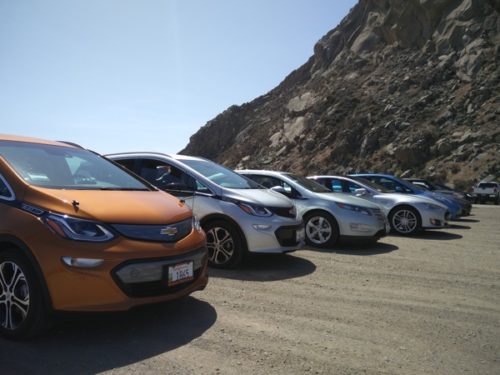
Two Chevy Bolts, a Volt, a Tesla S and several others at Morro Rock, San Luis Obispo, CA. Photo Credit: Brennan Balson via National Drive Electric Week

Can I really afford this?

The sticker price on my particular model was well over $40k–way more than I would have considered spending on a car. However, with the Federal Tax Credit ($7500) and the NY State Dirve Clean Rebate ($2000), the cost decreased to something a bit more palatable. I chose a lease (which until very recently did not seem to be available for electric cars) and ended up paying only a few hundred dollars a month–similar to what you might pay for an ICE (Internal Combustion Engine) vehicle.  

What about charging?

There are a few ways you can charge your vehicle.  

  • Level 1 (the slowest) uses a standard household outlet to plug in the charging cable that came with the car. This is a very, very slow way to charge. It takes about 24-36 hours to get to close to an 80% charge. Not ideal. But in a pinch, you know you can at least add a few miles to get you where you want to go.
  • Level 2  These chargers can be found everywhere from municipal parking lots to shopping malls and are frequently free or very low cost. These use a 240v power connection and can usually charge your vehicle completely in under 6 hours. It is also possible to get one of these for your home. The charging units cost about $500, but many utilities offer these at a steep discount and the installation (if you need an electrician to install a 240v plug to support it) can be tax deductible (check with your accountant, if you got one).  
  • Level 3 – DC fast charging  These are much harder to find but are becoming more popular.  With DC charging you can get to an 80% charge within about 25-30 minutes. They are starting to pop-up in many shopping malls and highway rest stops, but there are still not enough to address the growing demand in certain areas of the country. These cost anywhere from $.35/kwh-$.50/kwh or roughly $.10 – $.25/mile. Still not bad compared to the cost of gas.

How does it perform and what does it cost to maintain?

Driving an electric car is pure joy. Once you have tried it, you will never want to go back. There is no noise or fumes, and the acceleration is instant. Best of all: No more trips to the gas station! Before the electric car, I was filling up roughly 2x per month and spending an average of $60. With the EV, I’m able to charge at home (overnight) for a fraction of the costs. O&R even offers a Time of Use plan for electric vehicle owners that significantly reduces your energy supply costs at night (when you are charging your EV). In addition, there are no more bi-annual trips to the repair shop to get oil changes and replace filters. The only maintenance recommended for my vehicle after 5k miles was to rotate the tires. There are additional perks for New Yorkers as an owner of an EV: you can qualify for an EZpass Discount and the NYS clean pass program (https://www.dot.ny.gov/programs/clean-pass) which lets you use HOV lanes on certain expressways.

What are the downsides?

With all-new technologies, there are certainly some things to be concerned about.  In my case, my car was recalled due to a faulty battery (read more) which was a very frustrating experience. I was given a loaner car (non-electric) for 4 weeks while I waited for the new battery (which basically encompasses the entire undercarriage of the car and weighs over 1500lbs) to arrive from the factory.  The Chevy Bolts now suffer from the same issue (read more

Charge anxiety is a real and persistent issue, especially for long car trips.  If you plan accordingly by mapping out your charging locations beforehand and give yourself enough spare charge to account for any changes in driving conditions, you should be fine. Check out PlugShare—an EV charging station finder to get the locations of charging stations along your route (with reviews) and whether or they are occupied or not operational for some reason.

Even with these potential issues, the savings and joys of driving an electric car are well worth it. It feels different… in a good, modern way. Makes you aware of just how antiquated ICE cars are and how much better transportation can be.

Resources:

Green Car Reports – https://www.greencarreports.com/

NYSERDA – Drive Clean Rebate – https://www.nyserda.ny.gov/All%20Programs/Programs/Drive%20Clean%20Rebate

Federal Tax Credits for Electric Vehicles – https://fueleconomy.gov/feg/taxevb.shtml

EZPass Green Pass  – https://www.thruway.ny.gov/ezpass/greentag.html

NYS Clean Pass Program – https://www.dot.ny.gov/programs/clean-pass

Plug Share – https://www.plugshare.com/

Orange and Rockland Time of Use Program – https://www.oru.com/en/save-money/energy-saving-programs/time-of-use

About the author:

Addison Chappell is an Upper Nyack Resident, a member of the Upper Nyack Green committee and co-chair of the Upper Nyack CSC (Climate Smart Community) task force. 

This piece was originally published on Nyack News & Views (link to original here).